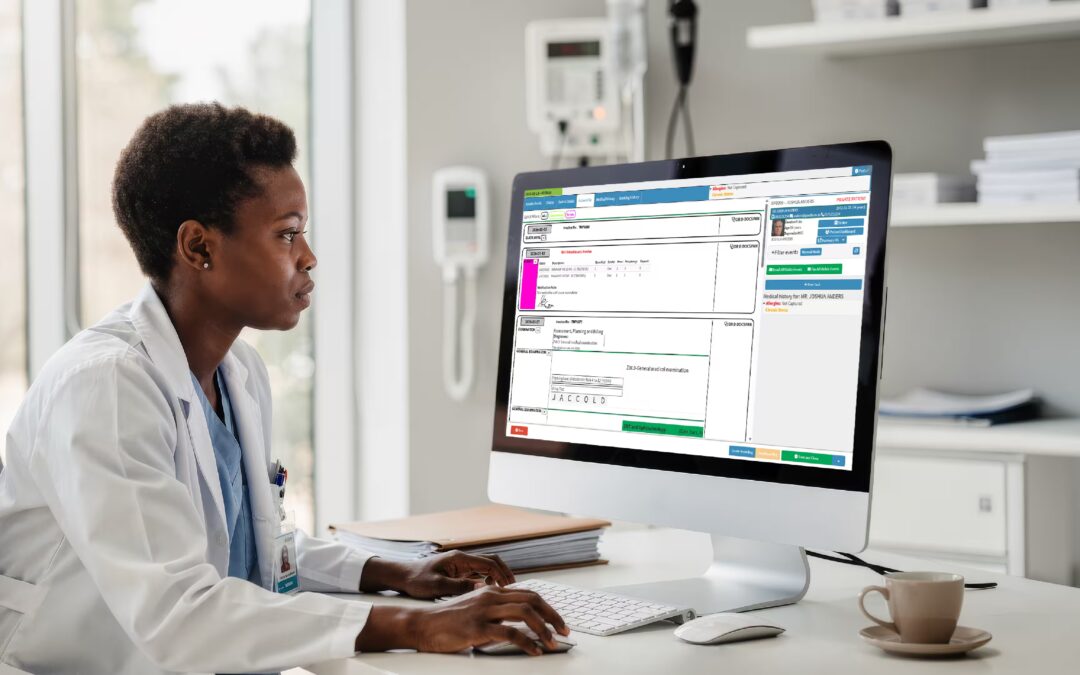
An electronic health record system is, at its simplest, a patient’s medical history stored and managed on a computer instead of in a paper folder. That sounds modest. In practice it changes how a whole clinic runs, because the same record can be opened by the GP, the nurse, and the billing clerk at once, without anyone hunting for a file.
Paper still lingers in plenty of Namibian practices. It is familiar, and it works right up until the folder is on the wrong desk.
So here is the full picture: what the system actually is, a real example of it in use, the advantages worth caring about, and why it matters as much to nurses as to doctors.
Electronic Health Record Example
Picture a patient with hypertension who comes in every three months. On paper, each visit is a loose page, and last year’s readings might be in a folder in storage. In an electronic health record, that patient is one continuous timeline.
The GP opens the record and sees the blood pressure trend at a glance, the current medication, the last lab result, and the note from the locum who saw the patient in March. Prescriptions are issued from the same screen. The billing flows from the consult automatically.
People often ask what are the three types of EHR, and the useful distinction is roughly this: a basic record that stores notes, a fuller system that adds prescribing and decision support, and a connected system that shares data across providers. The World Health Organization favours the connected end of that scale, because shared records are what stop care fragmenting between clinics.
10 Advantages of Electronic Health Records
The advantages stack up quickly once a practice commits. Records are legible, so no more squinting at a colleague’s handwriting. They are in one place, available the moment a patient walks in. They cut duplicate tests, because the last result is right there.
Beyond that: safer prescribing through drug interaction alerts, faster and cleaner billing, easier recall of chronic patients, a proper audit trail of who saw what, simpler reporting for the practice, better continuity when a patient sees a different clinician, and stronger data security than a folder that anyone in the corridor could pick up.
That is ten, and they are not theoretical. Reviews published in The BMJ link electronic records with fewer medication errors and better follow up of long term conditions, which is exactly where paper tends to let patients slip.
Electronic Health Records in Nursing
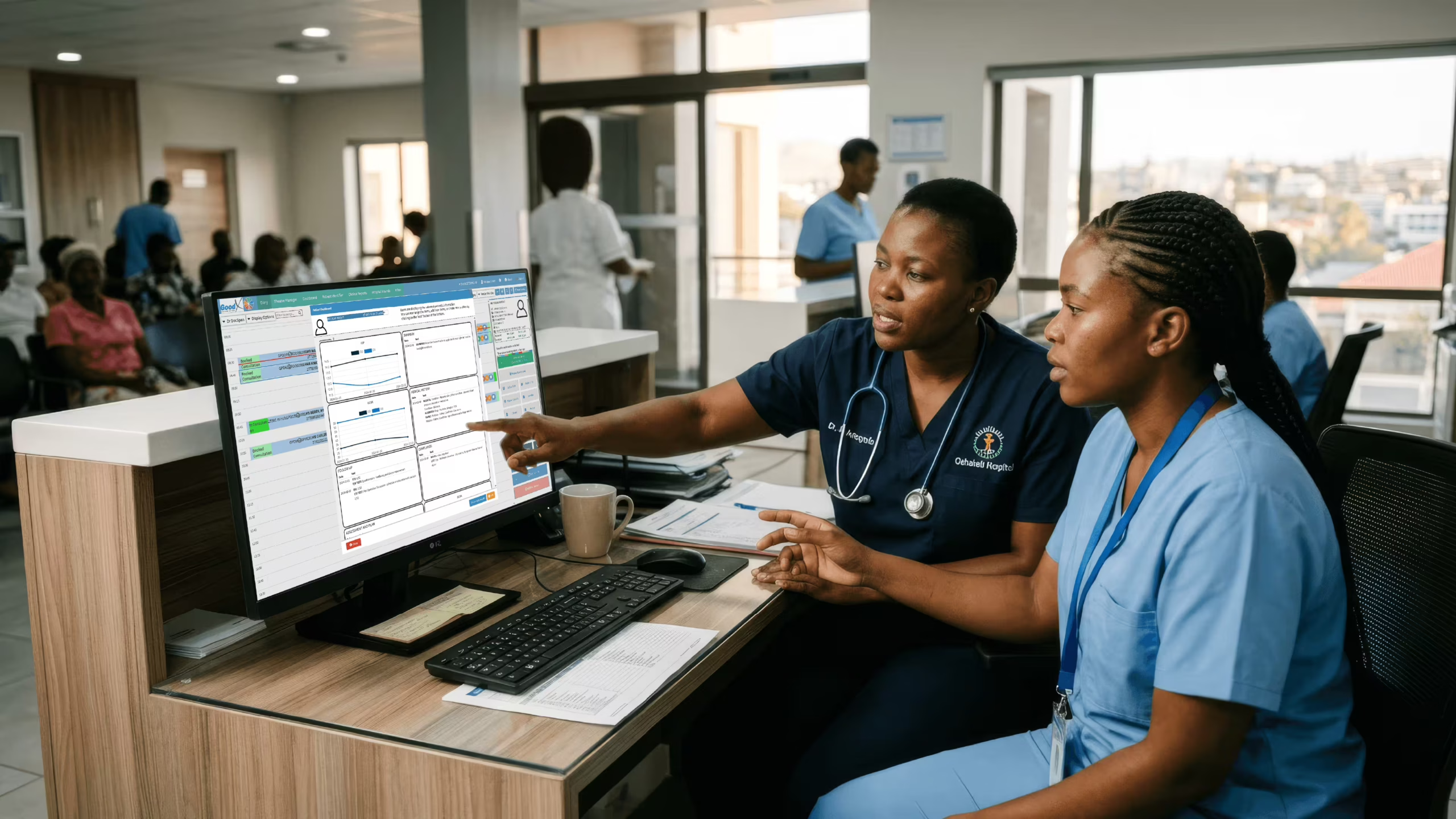
Nurses often feel the difference first, because so much of the daily record keeping lands on them. Observations, medication rounds, wound notes, handover. On paper, all of it is rewriting and rechecking.
With an electronic record, a nurse logs vitals once and they are visible to the whole team immediately. Medication administration is timed and tracked, which lowers the risk of a double dose or a missed one. Handover stops depending on whether the last shift wrote clearly.
As for what EHR do most hospitals use, the honest answer is the system that fits their setting and budget rather than a single global brand, and for many Namibian practices GoodX is built to be exactly that fit, designed for local workflows from the ground up. The World Bank has documented how digital health records strengthen health systems across the region, and Namibia sits squarely in that shift.
Moving From Paper Without the Chaos
The fear that keeps practices on paper is the switchover. Nobody wants to lose a patient’s history mid transition or grind the clinic to a halt for a fortnight while everyone learns a new system.
It does not have to go that way. Sensible practices move in stages. New patients and active files go digital first. Reception and nursing get a few short training sessions rather than one overwhelming day. Old paper records are scanned or summarised into the system over time, not all at once in a panic.
Pick a quieter stretch of the year if you can, and lean on the software provider for the heavy lifting of setup and data migration. Within a month or two the paper folder starts to feel like a relic, and the day a patient walks in and their whole history is already on screen is the day the change pays for itself.
Keeping Records Safe and Available
Going digital changes the nature of the risk. A paper file can be lost in a fire or left on the wrong desk. A digital record can be lost too, just differently, which is why how a system protects data matters as much as what it stores.
The two things to insist on are security and availability. Security means encryption, controlled access, and an audit trail, so only the right people see a record and every view is logged. Availability means reliable backups and the confidence that a hardware failure on a Monday does not erase a decade of histories.
Ask any provider where the data lives, how often it is backed up, and how quickly you could recover after a problem. A good answer is specific. A shrug is a warning, because a record you cannot reach when a patient is in front of you is not much of a record at all.
What to Expect in the First Month
The switch to an electronic record feels daunting until you have lived a few weeks of it. Knowing the shape of that first month takes some of the fear out.
Early on, things are a little slower as the team learns where everything sits. By the second or third week, muscle memory takes over and the questions dry up. Somewhere in there comes the moment a patient walks in and their full history is already on screen, no folder hunt required, and the old way starts to feel faintly absurd. Lean on your provider’s support hard in those first weeks, because that is when good habits are set.
Frequently Asked Questions
What is an electronic health record system?
It is a patient’s medical history stored and managed on a computer rather than on paper. One record holds notes, results, prescriptions, and billing, and the whole care team can open it at once, which keeps a patient’s history continuous instead of scattered across folders.
What are the three types of EHR?
Broadly, a basic record that stores notes, a fuller system that adds prescribing and clinical decision support, and a connected system that shares data across providers. The connected type delivers the most value, because shared records keep care joined up between clinics.
What are the main advantages of electronic health records?
Legible notes in one place, fewer duplicate tests, safer prescribing through interaction alerts, faster billing, easier recall of chronic patients, a clear audit trail, and stronger data security. Together they cut errors and free clinical time across the practice.
How do electronic health records help nurses?
Nurses log vitals and medication once, and the whole team sees it instantly. Medication rounds are timed and tracked, handover no longer hinges on legible handwriting, and the record updates in real time, which lowers the risk of missed or duplicated care.
Book Your Free GoodX Demo
An electronic health record only pays off when it connects to scheduling and billing too. GoodX brings all three together in one system built for Namibian practices.
See how a connected record would work in your clinic.